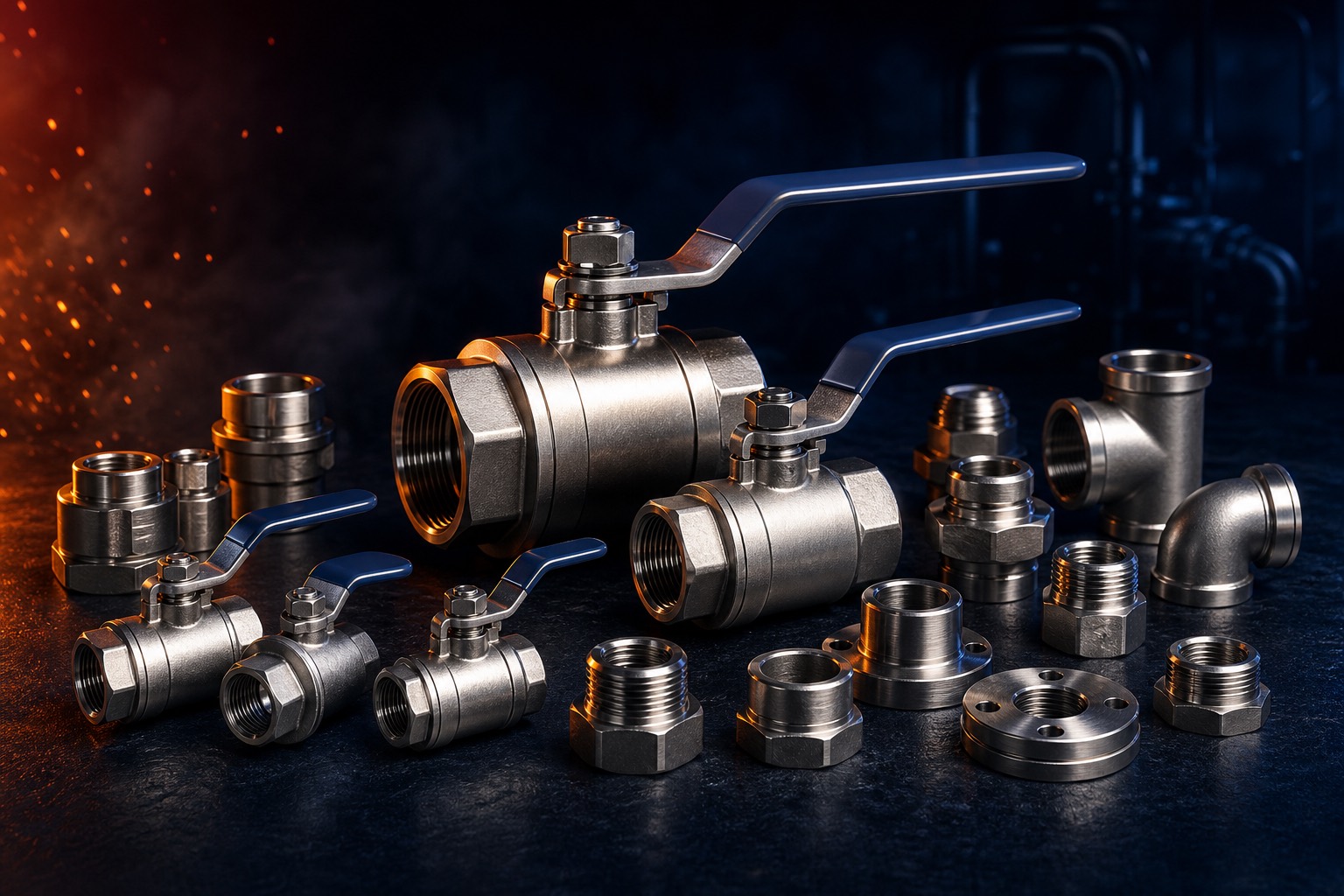
Why 304 — not 316 or 17-4?
For the majority of fire protection valves, bathroom fixtures, and water manifolds, AISI 304 stainless steel hits the sweet spot:
- Sufficient corrosion resistance for potable water and indoor sprinkler environments
- Lower alloy cost than 316 while outperforming brass on price stability
- Non-magnetic austenitic structure after solution treatment
- Proven MIM feedstock availability at scale
316 is reserved for aggressive chloride environments; 17-4 PH for high-strength structural parts. Most copper-to-steel conversion programs in our catalog target 304.
Sintered properties OEMs should specify
| Property | Typical MIM 304 target | Notes |
|---|---|---|
| Density | ≥ 7.60 g/cm³ (≥98% theoretical) | Measured by Archimedes method |
| Tensile strength | 500–550 MPa | As-sintered, before any HIP |
| Yield strength | 180–230 MPa | Depends on carbon control |
| Elongation | 40–50% | Higher than many cast grades |
| Hardness | HRB 65–75 | Machinable for critical fits |
Always request first-article inspection (FAI) data tied to your drawing — not generic material certs.
Corrosion: what changes vs brass
Brass relies on zinc depletion over time in aggressive water. 304 forms a passive chromium oxide layer — passivation after sintering is standard practice at MIM Precision.
For bathroom trim and manifold applications:
- Sinter in controlled atmosphere to limit carbon pickup
- Acid passivation per ASTM A967
- Validate with your internal spec (NSS 48h, water immersion, etc.)
Cost structure: why 304 MIM beats machined brass
Brass machined part cost ≈ (copper-indexed material) + (3–5 machining ops) + (plating) + scrap
304 MIM part cost      ≈ (stable stainless feedstock) + (near-net-shape) + (passivation)
When LME copper moves 15–20% in a quarter, brass BOMs shift — stainless feedstock does not. That predictability alone has driven multiple OEMs to qualify MIM 304 during 2024–2025 copper spikes.
Conversion readiness checklist
- Annual volume — Is the part above 50k units/year with stable demand?
- Geometry — Are there uniform walls (1.5–8 mm typical) without deep isolated cores?
- Pressure rating — Can your design tolerate MIM density and post-machining on sealing faces?
- Certification path — For fire protection, plan UL/FM evaluation at assembly level early.
Upload your drawing for a free DFM review — our engineers respond within 24 hours.
Explore related terms in our Knowledge Base.
Comments
Loading comments...